
According to the World Health Organization (WHO), hearing loss is on the rise and projected to affect 2.5 billion people worldwide by 2050.
This figure is nothing short of frightening when you consider the many health dangers and financial consequences of hearing loss. In this article, we’ll review these dangers in detail—and hopefully, you will be inspired to seek medical attention at the first sign of hearing decline.
1. Alzheimer’s, Dementia, and Cognitive Decline
Hearing loss is now recognized as one of the most significant modifiable risk factors for dementia, and research suggests that treating hearing loss with hearing aids may help reduce the risk of developing dementia.
A landmark 2020 report from the Lancet Commission identified hearing loss as the largest potentially modifiable risk factor for dementia in midlife, accounting for an estimated 8% of global dementia cases.
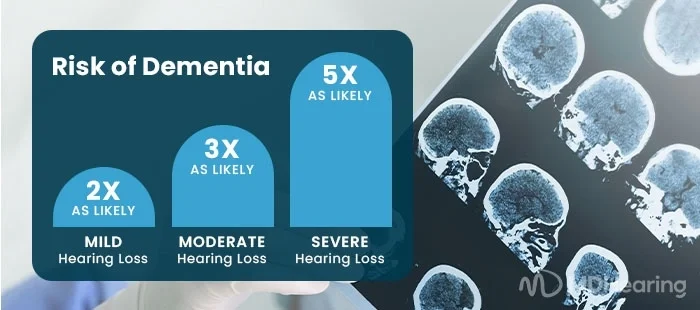
Earlier research from Johns Hopkins University found that the risk of dementia increases with the severity of hearing loss. Compared to adults with normal hearing, those with mild hearing loss had roughly double the risk of developing dementia. Moderate hearing loss tripled the risk, and severe hearing loss increased the risk up to fivefold.
More recently, a 2023 clinical trial by the National Institutes of Health (NIH) and Johns Hopkins provided encouraging evidence that treating hearing loss may help protect cognitive health. The study found that in older adults at higher risk for cognitive decline, hearing intervention (including hearing aids and counseling) slowed cognitive decline by nearly 50% over three years compared to a control group.
Lead author of the study, Alison Huang, PhD, MPH, said the following about the findings:
This study refines what we’ve observed about the link between hearing loss and dementia, and builds support for public health action to improve hearing care access.”
Researchers believe hearing loss may accelerate cognitive decline for several reasons:
The brain must work harder to process sound signals, diverting resources from memory and thinking
Reduced hearing can lead to social isolation, which is a major dementia risk factor itself
Long-term auditory deprivation may contribute to structural brain changes
While hearing aids are not a cure for Alzheimer’s disease and dementia, growing evidence indicates that treating hearing loss may be one of the most practical steps adults can take to help protect long-term brain health.
Early detection is key. The American Speech-Language-Hearing Association recommends hearing screenings at least once every 10 years through age 50, and every one to three years after that. Identifying and addressing hearing loss early may help reduce its impact not only on communication—but also on cognitive health and overall well-being.
2. Loss of Speech Comprehension
Before dementia becomes a concern, hearing loss begins to affect something far more immediate: your ability to understand everyday conversation, or more formally, speech comprehension.
Many people with early hearing loss can still hear that someone is speaking, but speech sounds muffled, unclear, or incomplete. You may find yourself asking “What?” or “Can you repeat that?” more often, especially in noisy environments.
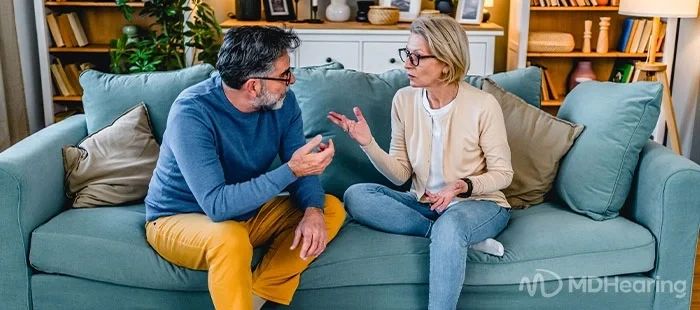
This happens because hearing is not just conducted through the ears—it’s also conducted through the brain. When the brain receives incomplete or distorted sound signals, it must work harder to fill in the gaps.
Many researchers agree that the concept of “use-it-or-lose-it” applies to the loss of speech comprehension skills. They theorize that the less we can hear, the less we exercise the areas of the brain required to understand speech. Eventually, this lack of stimulation weakens the brain’s speech processing and comprehension capabilities.
Fortunately, there are two ways you can exercise and improve speech comprehension at the brain level:
Speech comprehension brain exercises: Smartphone apps, such as eargym or Constant Therapy, offer interactive auditory training exercises designed to help users better understand speech by strengthening listening skills, attention, and auditory processing.
Hearing aids: Treating hearing loss with hearing aids as early as possible is extremely important, as hearing aids help strengthen your brain’s ability to understand speech. By providing your brain with consistent sound and speech stimulation, hearing aids help keep your speech comprehension skills as strong as possible.
If you find yourself struggling to follow conversations, it may be time to evaluate your hearing. MDHearing offers a free online hearing test you can take from your computer, smartphone, or tablet to better understand your hearing health.
3. Fire Alarms and Warning Signals
Our safety often depends on our ability to hear alarms, alerts, and other warning signals. However, many of these alarms—especially smoke alarms—emit pure tone signals in the 3000 to 4000 Hz range. This frequency range is extremely difficult to hear for people with high-frequency hearing loss.
According to researcher Dr. Dorothy Buck,
Lots of people over 60 have high-frequency hearing loss… Those sorts of things put people at risk. There is a reduced chance that you will wake up to the current high-pitched smoke alarm.”
For nighttime safety, specialized hearing-impaired fire alarms, such as Lifetone or First Alert, can help by emitting a lower-frequency tone that’s easier to hear or using bright flashing lights.
But safety risks don’t just happen while you’re asleep. When you’re awake and moving through your day, hearing plays a critical role in keeping you aware of your surroundings. That’s where hearing aids can make a life-saving difference.

Consider some of the most important sounds that could save your life if you’re able to hear them:
Fire and smoke alarms
Ambulance, fire truck, and police sirens on the road
Honking horns or an approaching vehicle while walking
Windows breaking during a burglary
Home and car burglar alarms
Backup alarms on a forklift or other equipment
An urgent phone call from a loved one in trouble
Hearing aids amplify and clarify these important environmental sounds, helping you respond quickly and stay aware of your surroundings. Beyond improving conversations, hearing aids play an essential role in everyday safety.
4. Falling Dangers
Hearing loss is connected to a higher likelihood of falls and fall-related injuries, with the risk increasing as the severity of hearing loss worsens. According to a study by John Hopkins, only 25-decibels of hearing loss (equivalent from going from normal to mild hearing loss) triples your chances of falling. For every 10 decibels of hearing loss beyond that, the risk of falling increases by 140%.
Why do people with hearing loss have a greater risk of falling? The author of the study, Dr. Frank Lin, believes that reduced hearing puts additional demands on our brains, leading to cognitive overload which interferes with balance:
Gait and balance are things most people take for granted, but they are actually very cognitively demanding. If hearing loss imposes a cognitive load, there may be fewer cognitive resources to help with maintaining balance and gait.”
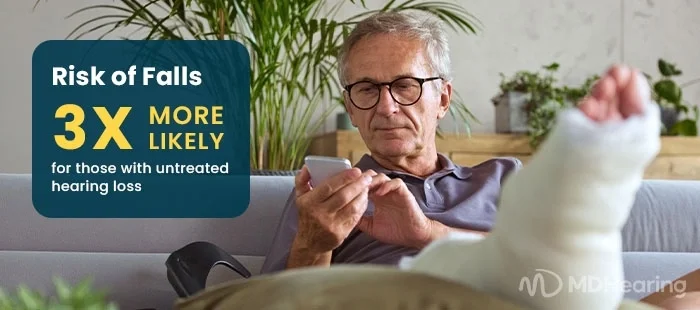
The danger of falling is particularly scary when you consider the health and financial costs. Falls are the leading cause of injury-related death among adults ages 65 and older, and approximately $50 billion in medical costs across the U.S. according to the U.S. Centers for Disease Control and Prevention.
Hearing aids offer an excellent solution to minimize the risk of falling. A Washington University study reported that hearing aids in both ears offered a considerable improvement in balance and reduced risk of falling when they were turned on versus when they were turned off.
Here’s what researchers found in their tests:
Foam pad test: Patients maintained their balance for approximately 17 seconds when hearing aids were off. They maintained their balance for approximately 26 seconds when hearing aids were on.
Heal-to-toe test: Patients maintained their balance for approximately 5 seconds when hearing aids were off. They maintained their balance for approximately 10 seconds when hearing aids were on.
The author of the Washington University study, Dr. Timothy E. Hullar, believes that hearing aids help because sound information is an integral part of balance:
We don’t think it’s just that wearing hearing aids makes the person more alert. The participants appeared to be using the sound information coming through their hearing aids as auditory reference points or landmarks to help maintain balance. It’s a bit like using your eyes to tell where you are in space. If we turn out the lights, people sway a little bit — more than they would if they could see. This study suggests that opening your ears also gives you information about balance.”
5. Depression
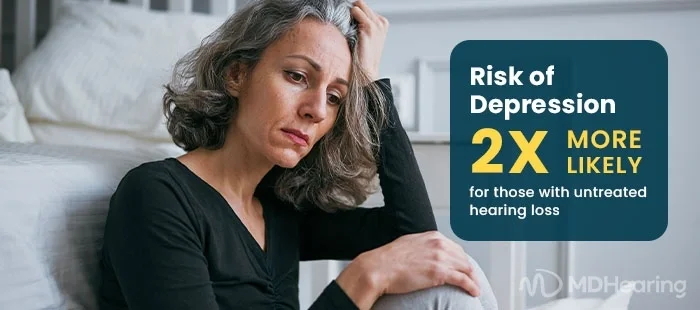
Depression is another health danger that goes hand-in-hand with hearing loss. A report published by the National Institute on Deafness and Other Communication Disorders (NIDCD) indicates that adults with hearing loss are almost twice as likely to suffer from depression:
The prevalence of moderate to severe depression was higher among U.S. adults aged 18 or older with self-reported hearing impairment (11.4 percent) compared to those without hearing impairment (5.9 percent).”
Another study by The Gerontologist corroborates the results:
Compared to people without hearing loss, older adults with some form of hearing loss were 47 percent more likely to have symptoms of depression.”
The apparent correlation between depression and hearing loss suggests how important it is to treat hearing loss as soon as possible. From a quality of life perspective, hearing aids could dramatically improve an individual’s psychological welfare and happiness.
6. Lower Incomes
Hearing loss doesn’t just affect your health—it can impact your finances as well. A 2023 systematic review examined decades of research on adult-onset hearing loss and income and found a consistent link between hearing loss and economic hardship.
Compared to those with normal hearing, one of the cited studies found that adults with hearing loss (ages 20 to 69) have higher chances of:
Low income: 1.58 times higher odds
Unemployment or underemployment: 1.98 times higher chance
Low education attainment: 3.21 times higher chance
Communication challenges in the workplace can lead to missed opportunities, reduced productivity, social withdrawal, and difficulty advancing professionally.

Additional research from the Better Hearing Institute revealed just how dramatic the income disparity can get for patients with untreated hearing loss. Dr. Mark Ross, an audiologist and researcher from Gallaudet University, summarized the results of the study as follows:
For the group with the most severe hearing losses (10 percent of the total), the income differential between the aided and unaided groups reaches the rather astounding figure of $31,000 a year! This is how much less people with the most severe, unaided hearing loss make compared to a comparable group of hearing aid users. This is clearly a horrendous and discouraging figure …”
When hearing loss goes untreated, the consequences can quietly compound—affecting not just conversations and health, but confidence, career growth, and long-term financial stability.
Prevent the Dangers of Hearing Loss with MDHearing
Considering the serious consequences of hearing loss—including cognitive decline, Alzheimer’s, depression, safety concerns, and lost income—investing in a set of hearing aids could be one of the best decisions you make to safeguard your health and financial security in the years ahead.
At MDHearing, we offer a variety of high-quality, FDA-registered OTC hearing aids at a fraction of the traditional clinic cost. Instead of charging nearly $5,000, our hearing aids range from $297–$597 per pair and are delivered directly to your door—making better hearing significantly more accessible.
But affordability doesn’t mean you’re on your own. Our U.S.-based team of licensed audiologists and hearing specialists is here to guide you every step of the way. They can help you choose the hearing solution that best fits your lifestyle and level of hearing loss, provide personalized setup assistance, and offer troubleshooting and ongoing support after your purchase. You get professional clinic-level guidance—without the high clinic price tag.
Best of all, every hearing aid is backed by our 60-day risk-free trial. If your hearing aids aren’t the right fit, you can return them with confidence.
Have you noticed any signs of hearing decline? Take our quick and easy online hearing test and get your results instantly.
TAKE ONLINE HEARING TEST